
Pajak
Value Added Tax (VAT) in Free Trade Zones and Free Ports (FTZ): What You Need to Know

Free Trade Zones and Free Ports (FTZ) are subject to specific tax regulations, including the treatment of Value Added Tax (VAT) on transactions involving goods and services. These provisions are important for companies conducting transactions with parties located within free trade zones. One of the legal bases is Minister of Finance Regulation (PMK) Number 173/PMK.03/2021 concerning Tax Treatment of the Supply of Taxable Goods (BKP) and/or Taxable Services (JKP) in Free Trade Zones and Free Ports (KPBPB).
What Is a Free Trade Zone and Free Port (FTZ)?
A Free Trade Zone and Free Port (FTZ), or KPBPB, is an area granted certain tax and customs facilities. For certain transactions, the supply of Taxable Goods (BKP) and/or Taxable Services (JKP) to an FTZ may qualify for the VAT not collected facility, subject to the applicable regulations.
VAT Facilities in FTZs
The supply of tangible Taxable Goods (BKP) from Other Places Within the Customs Area (TLDDP), Bonded Zones (TPB), or Special Economic Zones (KEK) to an FTZ may qualify for the VAT not collected facility if the prescribed requirements are met. In practice, the transaction must be supported by the appropriate administrative documents, one of which is the Notification of Acquisition or Removal of Goods/Services (PPBJ).
What Is PPBJ?
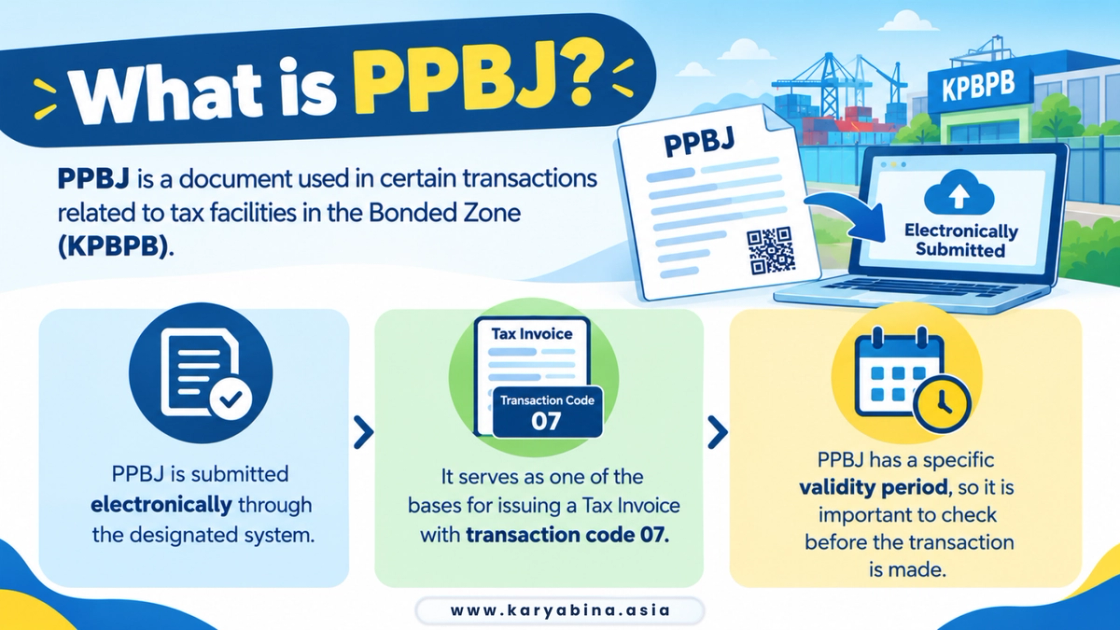
PPBJ is a document used for certain transactions related to tax facilities in FTZs. PPBJ is submitted electronically through the designated system and serves as one of the bases for issuing a Tax Invoice using transaction code 07. PPBJ also has a specific validity period, which must be taken into consideration before the transaction is carried out.
Endorsement in FTZ Transactions
In addition to PPBJ, there is an Endorsement mechanism related to verifying that goods receiving the tax facility have actually entered the FTZ. The Endorsement process is conducted electronically and is supported by documents such as customs declaration documents, approval for the release of goods, and Tax Invoices. If the required requirements or documents are not fulfilled, the VAT not collected facility may not be granted in accordance with the applicable provisions.
Tax Invoices for Transactions to FTZs
For transactions that qualify for the VAT not collected facility, Taxable Entrepreneurs (PKP) need to comply with the provisions for issuing Tax Invoices, including the use of transaction code 07 and the inclusion of the required information. Ensuring consistency among the PPBJ, Tax Invoice, and customs documents is an important part of FTZ transaction administration.
What Happens When Goods Leave an FTZ?
Unlike the supply of goods to an FTZ, the removal of Taxable Goods (BKP) from an FTZ to Other Places Within the Customs Area (TLDDP) may generally be subject to VAT and/or Luxury Goods Sales Tax (PPnBM), in accordance with the applicable regulations. Under certain circumstances, special treatment may apply, such as the temporary removal of goods or certain transactions that meet the prescribed requirements.
The Importance of VAT Administration in FTZs
Transactions involving FTZs are subject to specific administrative requirements. Errors in PPBJ, Tax Invoices, customs documents, or the Endorsement process may affect the granting of tax facilities. Therefore, companies need to ensure that each transaction meets all applicable requirements before utilizing VAT facilities in an FTZ.
Conclusion
The treatment of Value Added Tax (VAT) on transactions involving Free Trade Zones and Free Ports (FTZs) is subject to specific provisions and administrative requirements. The VAT not collected facility may be granted for certain transactions provided that the applicable requirements are fulfilled, including the completeness of PPBJ, Tax Invoices, customs documents, and Endorsement. Therefore, understanding VAT provisions applicable to FTZs is important for companies to ensure that tax facilities are utilized appropriately and that tax administration remains compliant with the applicable regulations.
Tax support for companies in Malang City and Malang Regency, from the KBA Consultant office in Kota Batu, is on the tax consultant in Malang page.